


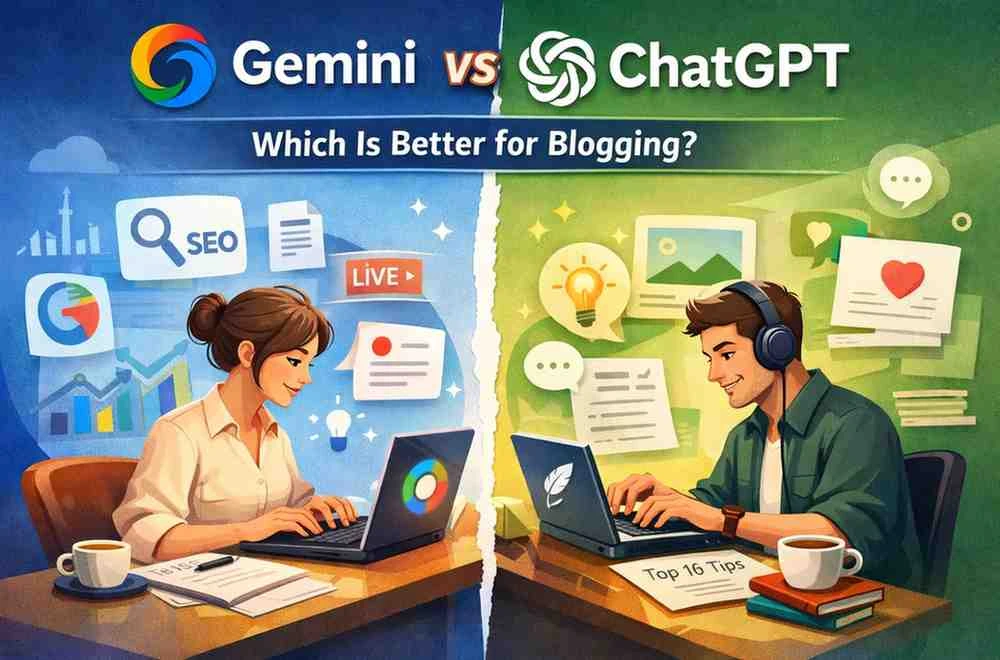
Blogging is a competitive sport these days — not because writers have become fearless warriors, but because AI tools now decide who gets eyeballs and who gets crickets. Two popular AI assistants dominate the landscape: Google’s Gemini and OpenAI’s ChatGPT. Both promise to help bloggers write faster, research smarter, and rank higher. But which one genuinely delivers for blogging in 2026?
Gemini vs ChatGPT for blogging has become a hot topic as content creators look for smarter ways to write faster, rank higher, and maintain quality without burnout.
In this article, we’ll unpack their strengths, weaknesses, real-world use cases, and which tool fits your blogging workflow best — without fluff or guesswork.
What Are Gemini and ChatGPT?
Before picking sides, it helps to know what each tool is.
ChatGPT is a conversational AI from OpenAI, known for its strong creative output and natural-language writing. It’s powered by advanced large language models such as GPT-5 and GPT-5.1, capable of processing text, images, and more. You can explore its capabilities directly on the official ChatGPT website by OpenAI (https://chatgpt.com).
Google Gemini comes from Google’s DeepMind team and focuses heavily on integrating with Google products and real-time data insights. It’s designed to be research-driven, concise, and fact-oriented.
Google explains its vision and features on the official Gemini page (https://gemini.google.com).
Both tools are evolving rapidly, so what was true last year might not hold tomorrow — but as of 2026, here’s the comparison that matters.
How They Compare for Blogging
Let’s break down the core tasks involved in blogging and see how Gemini and ChatGPT perform.
When comparing Gemini vs ChatGPT for blogging, the real difference lies in creativity, SEO support, and research accuracy.
1. Content Quality & Creativity
If your blog thrives on storytelling, engaging introductions, creative metaphors, or human-like tone, ChatGPT typically leads.
Many reviewers note that ChatGPT generates more cohesive, readable, and creative long-form content compared to Gemini, making it especially strong for narrative writing and copy-heavy posts.
According to multiple AI content reviews, ChatGPT generally produces more human-like and engaging long-form content, especially for storytelling blogs and opinion-based articles.
This difference is highlighted in detailed comparisons by platforms like DigitalOcean.
DigitalOcean comparison: https://www.digitalocean.com/resources/articles/gemini-vs-chatgpt
👉 Example: A travel blog section or “why this product matters” paragraph feels more natural with ChatGPT.
Gemini, on the other hand, tends to produce more concise and data-driven responses, which are great for fact-based posts, step-by-step tutorials, or technical writing.
Humor break: Think of ChatGPT as your witty storytelling friend and Gemini as the studious librarian — both helpful, but in very different ways.
2. SEO Support & Keyword Alignment
Search Engine Optimization (SEO) is crucial if you want your blog to rank on Google. AI tools can assist with keyword suggestions, metadata creation, and topical relevance.
Gemini’s strong suit is its real-time data alignment with Google Search and structured suggestions — making it excellent for building SEO-friendly outlines and ensuring you cover topics comprehensively.
Meanwhile, ChatGPT is trusted for keyword context placement and readability, helping you weave keywords naturally into paragraphs. It’s also popular among SEO professionals for creating engaging meta titles, descriptions, and internal links.
From an SEO perspective, both tools support keyword placement and topic coverage. However, Gemini benefits from Google’s search ecosystem and real-time understanding of search intent, while ChatGPT focuses on natural keyword flow and readability.
Pro Tip: Google advises focusing on content usefulness rather than keyword stuffing — so using both tools strategically can balance creativity with SEO relevance.
3. Research & Accuracy
For research-heavy blogging — where accuracy matters — Gemini often has the edge due to its ability to pull up-to-date facts and integrate with live search contexts.
If you need fresh statistics, fact checks, or long lists of technical tips, Gemini’s structured output can save editing time.
ChatGPT also performs strong research but may sometimes generalize information rather than precision-fact check — especially when offline or without up-to-minute search integration.
For research-heavy blogging, Gemini often performs better with structured and fact-based responses, especially when current information is required. This distinction is discussed in content-focused AI evaluations by DataCamp and Appy Pie Automate.
With the launch of Google Gemini 3 features, the platform has further improved its real-time search integration and fact-checking capabilities.
DataCamp review:
https://www.datacamp.com/blog/gemini-vs-chatgpt
Appy Pie Automate comparison:
https://www.appypieautomate.ai/blog/comparison/gemini-vs-chatgpt
4. Speed & Workflow Integration
Gemini is praised for delivering faster response times and tight integration with Google’s ecosystem (Docs, Drive, Gmail). This can make workflow smoother for bloggers who work predominantly inside Google tools.
ChatGPT shines with versatile integrations, plugins, and customization options — especially in writing workflows that include research automation, brainstorming, and editing tools.
So, if you’re a Chrome + Google Docs blogger, Gemini might feel like slipping into a familiar jacket. And if you prefer a flexible writing desk with more plugin options, ChatGPT could be your go-to.
5. Multimodal Features (Images & More)
Both AIs now support multimodal input — meaning you can use images, audio, and more in prompts. ChatGPT uses models like GPT Image for rich visuals integrated into text generation.
Gemini also offers cutting-edge visual input and output, especially if you’re using it to generate charts, graphic content, or visual explanations.
In short: Both tools can help you craft engaging blog posts with images — but the choice comes down to the kind of visuals and how much control you want.
Both platforms now support multimodal capabilities, including image and document understanding. OpenAI documents this evolution through its GPT models, while Google continues expanding Gemini’s multimodal intelligence.

Pros & Cons at a Glance
Here’s a simple comparison to help you decide quickly:
| Feature | ChatGPT | Gemini |
| Creativity & Flow | ⭐⭐⭐⭐ | ⭐⭐⭐ |
| Structured, Fact-based Writing | ⭐⭐⭐ | ⭐⭐⭐⭐ |
| SEO & Keyword Strategy | ⭐⭐⭐⭐ | ⭐⭐⭐⭐(real-time data edge) |
| Speed & Google Integration | ⭐⭐⭐ | ⭐⭐⭐⭐ |
| Ease of Use for Bloggers | ⭐⭐⭐⭐ | ⭐⭐⭐ |
| Multimodal Support | ⭐⭐⭐⭐ | ⭐⭐⭐⭐ |
Both tools have strengths — the question is which ones align with your priorities.
Choosing the Best Tool for Your Blogging Style
Rather than asking “Which tool is better?” try asking “Which tool fits my process?” Here’s how to decide:
📝 If you focus on personality-driven, engaging blogs…
➡️ ChatGPT is often better at crafting readable, natural, and shareable content.
📊 If you publish research-heavy, fact-driven posts…
➡️ Gemini can help you collect and structure complex information efficiently.
💡 If you want balanced SEO + creative writing…
➡️ A hybrid approach — drafting with ChatGPT and refining with Gemini — often works best.
Still unsure which AI tool suits your blogging style? Watch this quick video to see how Gemini and ChatGPT compare in real-world blogging tasks, from writing content to optimizing for SEO.
Common Blogging Workflow With AI (Example)
Here’s a practical sequence you can use:
- Outline Creation (Gemini): Ask for a topic outline with SEO focus and relevant subheadings.
- Draft Writing (ChatGPT): Write engaging draft content with natural flow and personality.
- SEO Refinement (Gemini): Add or refine keywords, meta titles, and schema basics.
- Fact Check (Both): Validate real facts with Gemini and revise readability with ChatGPT.
- Final Proofread (Human): Always edit manually — AI can speed things up, but humans still judge quality.
This workflow balances speed, SEO accuracy, and content quality.
Final Verdict — Who Wins?
Choosing between Gemini vs ChatGPT for blogging depends on your content style, SEO goals, and workflow preferences.
There’s no one-size-fits-all answer. But here’s our crisp conclusion:
- ChatGPT leads for creativity, storytelling, and engaging content writing — ideal for lifestyle, personal, or narrative blogs.
- 🎯 Gemini excels in research depth, structured SEO insights, and Google ecosystem integration — excellent for data-rich, technical, or SEO-heavy posts.
- 🎯 Best Choice: Use both tools in tandem, depending on the stage of your blogging workflow.
Many bloggers now use a hybrid workflow — drafting content with ChatGPT and validating structure or SEO intent with Gemini. This combined approach is also recommended by AI productivity blogs analyzing real-world blogging workflows.
Smartli AI blogging comparison:
https://www.smartli.ai/blog/chatgpt-vs-gemini-blog-writing
For more trending updates and tech insights, explore more on Wordsfloww.